Understanding official rudraksha testing charges in India is critical before you invest thousands of rupees in sacred Himalayan beads or malas. With counterfeit rates exceeding 65% in unverified commercial retail markets (Source: All India Gemological Society market surveillance & RT-Lab diagnostic intake data), professional laboratory authentication is your only genuine safeguard against carved lines, chemical hardening, and glue fusions. But how much should legitimate laboratory testing cost, and what specific diagnostic tests does your testing fee actually cover?
Why Rudraksha Testing Prices Vary Across India
If you search for bead certification online or in temple bazaars, you will encounter quotes ranging from as low as ₹100 up to ₹2,500. This massive price disparity exists because not all “certificates” represent authentic scientific testing:
- The ₹100–₹200 “Laminated Plastic Card” Trap: Many unregulated merchants issue instant printed cards with zero testing. No X-ray equipment is used, no gemological report number is archived in a searchable cloud database, and the card simply repeats whatever mukhi count the seller claims.
- Commercial Diagnostic Labs (₹500 to ₹1,500): Accredited testing facilities utilize high-resolution digital X-ray radiography machines, high-power optical stereomicroscopes, calibrated digital micrometers, and hydrostatic density balances. This testing requires capital investment, certified gemologists, and cloud infrastructure to ensure tamper-proof online verification.
Transparent Rudraksha Testing Charges: Detailed Fee Schedule
At RT-Lab, we maintain a completely transparent fee schedule with no hidden fees or surprise surcharges. Every test includes digital radiography, microscopic inspection, physical measurements, a laminated A4 archival certificate, a pocket-sized PVC Smart Card, and lifetime online verification.
| Specimen Category |
Mukhi Range / Type |
Standard Test Fee |
Diagnostic Inclusions |
| Single Standard Bead |
1 Mukhi to 14 Mukhi (Nepal / Java) |
₹650 |
Single X-ray radiograph, 50x groove check, A4 Certificate + PVC Smart Card |
| Rare Collector Bead |
15 Mukhi to 21 Mukhi |
₹950 |
Multi-angle high-resolution radiography, internal locule count, comprehensive dossier |
| Botanical Fusions |
Gauri Shankar / Garbh Gauri |
₹850 |
Joint-line radiography to differentiate natural twin join from synthetic glue |
| Triple Fusion Specialty |
Trijuti (Brahma, Vishnu, Mahesh) |
₹1,450 |
3D multi-axial digital radiograph and cellular wall integrity verification |
| Multi-Bead Mala / Kantha |
Siddha Mala (1–14 Mukhi + Gauri Shankar + Ganesh) |
₹3,800 – ₹5,500 |
Complete Multi-Bead Dossier, composite radiograph chart, individual bead entries |
What Every Testing Fee Delivers
Here is the exact tamper-proof multi-bead certificate dossier generated for tested malas and bracelets:
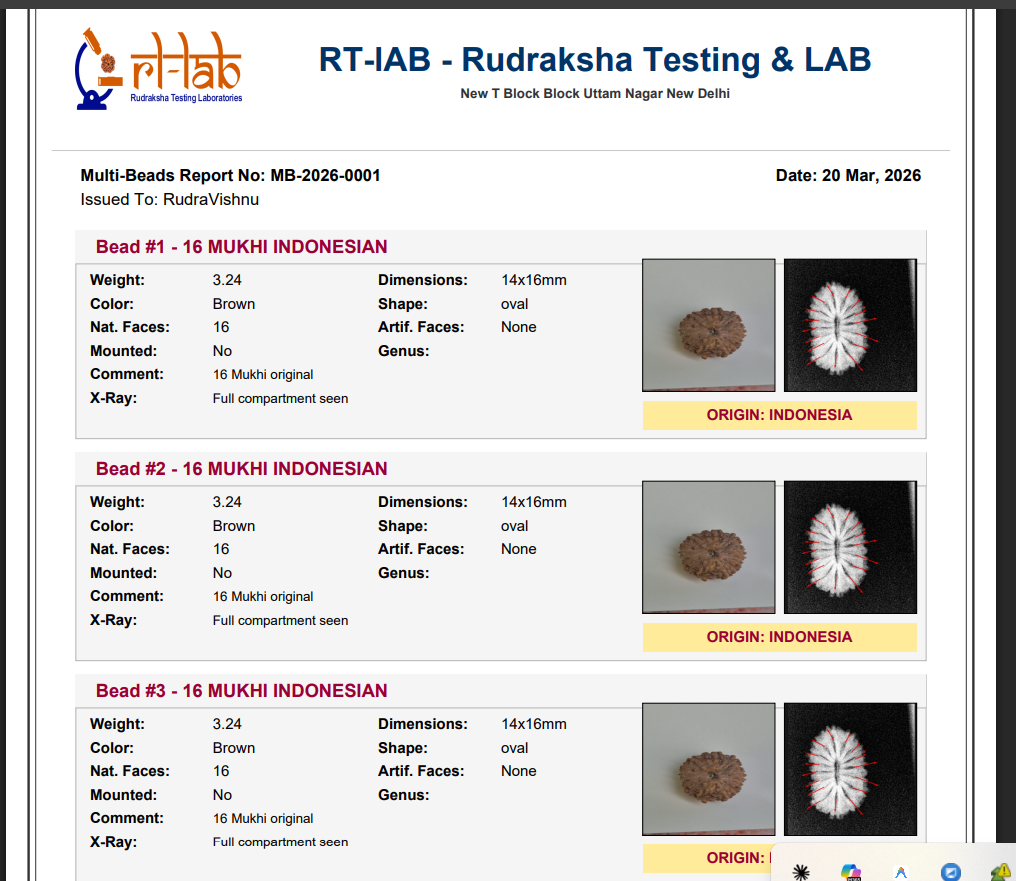
Sample Multi-Bead Report #MB-2026-0001 with individual radiograph locule table. Test verification online →
What Does Your Testing Fee Actually Pay For?
When you submit a bead for certification, your fee is distributed across four critical scientific procedures:
1. Industrial Digital Radiography Equipment Maintenance
Unlike medical X-ray systems tuned for human bone density, botanical radiography requires low-kilovoltage, micro-focus industrial tubes to capture delicate cellulose locule walls and internal seeds without burning out the image. Operating and calibrating this equipment to ISO radiation safety standards represents a substantial clinical overhead.
2. Certified Gemological Labor
Interpreting a radiograph requires botanical expertise. A trained gemologist must distinguish between natural seed locule partitions and artificial drill holes or resin infills. Every report must be signed off by a qualified technician.
3. Physical Archival Documentation & Security Smart Cards
Each client receives a full-sized 300 GSM water-resistant A4 laboratory report with micro-line guilloche patterns and a UV-reactive security crest. Additionally, RT-Lab issues a durable pocket-sized PVC Smart Card that fits in your wallet, equipped with a direct QR code linking to our live cloud database.
4. Cloud Verification Database & Lifetime Server Hosting
A certificate is useless if a buyer cannot verify it five years from now. A portion of every testing fee funds persistent, redundant cloud database hosting, ensuring your certificate number and specimen photographs remain verifiable 24/7/365 anywhere in the world.
The True Value: ₹650 vs Risking ₹25,000–₹1,50,000
Consider the cost ratio: A natural 14 Mukhi Nepal Rudraksha trades between ₹45,000 and ₹90,000, while a rare 21 Mukhi can command upwards of ₹5,00,000. Spending ₹650 to ₹950 on an accredited laboratory test represents less than 1% to 2% of your purchase price, yet protects 100% of your capital from counterfeit scams.
Related Laboratory Resources & Verification Links
Frequently Asked Questions (FAQ)
What are the standard rudraksha testing charges in India?
Standard rudraksha testing charges in India range between ₹650 and ₹950 for single beads (1 to 14 Mukhi), ₹950 for rare collector beads (15 to 21 Mukhi), and ₹850 for Gauri Shankar specimens. Multi-bead malas and Siddha malas range from ₹3,800 to ₹5,500 depending on bead count.
Are there extra courier charges when sending beads for testing?
Clients pay for outward courier shipping to the lab. For return delivery, insured tracked courier shipping across India is provided at a nominal flat fee of ₹150–₹250, including tamper-proof blister packaging and insurance handling.
Why do some sellers offer “free” lab certificates?
Free certificates provided by sellers are almost always in-house printed cards created without actual X-ray radiography or independent gemological validation. Always insist on independent, third-party laboratory verification with an active QR code and cloud record.
Do you offer wholesale testing discounts for merchants and jewelers?
Yes. RT-Lab provides tiered commercial pricing for merchants, exporters, and temple trusts testing batches of 25, 50, or 100+ beads. Contact our commercial desk on WhatsApp (+91-9711894156) for corporate rate cards.
Get an Instant Quote for Your Rudraksha Testing
Have a single bead, rare collector mukhi, or complete Siddha Mala? Message our laboratory desk on WhatsApp for exact pricing and courier booking instructions.
Inquire on WhatsApp: +91-9711894156


Understanding official rudraksha testing charges in India is critical before you invest thousands of rupees in sacred Himalayan beads or malas. With counterfeit rates exceeding 65% in unverified commercial retail markets (Source: All India Gemological Society market surveillance & RT-Lab diagnostic intake data), professional laboratory authentication is your only genuine safeguard against carved lines, chemical hardening, and glue fusions. But how much should legitimate laboratory testing cost, and what specific diagnostic tests does your testing fee actually cover?
Why Rudraksha Testing Prices Vary Across India
If you search for bead certification online or in temple bazaars, you will encounter quotes ranging from as low as ₹100 up to ₹2,500. This massive price disparity exists because not all “certificates” represent authentic scientific testing:
Transparent Rudraksha Testing Charges: Detailed Fee Schedule
At RT-Lab, we maintain a completely transparent fee schedule with no hidden fees or surprise surcharges. Every test includes digital radiography, microscopic inspection, physical measurements, a laminated A4 archival certificate, a pocket-sized PVC Smart Card, and lifetime online verification.
What Every Testing Fee Delivers
Here is the exact tamper-proof multi-bead certificate dossier generated for tested malas and bracelets:
Sample Multi-Bead Report #MB-2026-0001 with individual radiograph locule table. Test verification online →
What Does Your Testing Fee Actually Pay For?
When you submit a bead for certification, your fee is distributed across four critical scientific procedures:
1. Industrial Digital Radiography Equipment Maintenance
Unlike medical X-ray systems tuned for human bone density, botanical radiography requires low-kilovoltage, micro-focus industrial tubes to capture delicate cellulose locule walls and internal seeds without burning out the image. Operating and calibrating this equipment to ISO radiation safety standards represents a substantial clinical overhead.
2. Certified Gemological Labor
Interpreting a radiograph requires botanical expertise. A trained gemologist must distinguish between natural seed locule partitions and artificial drill holes or resin infills. Every report must be signed off by a qualified technician.
3. Physical Archival Documentation & Security Smart Cards
Each client receives a full-sized 300 GSM water-resistant A4 laboratory report with micro-line guilloche patterns and a UV-reactive security crest. Additionally, RT-Lab issues a durable pocket-sized PVC Smart Card that fits in your wallet, equipped with a direct QR code linking to our live cloud database.
4. Cloud Verification Database & Lifetime Server Hosting
A certificate is useless if a buyer cannot verify it five years from now. A portion of every testing fee funds persistent, redundant cloud database hosting, ensuring your certificate number and specimen photographs remain verifiable 24/7/365 anywhere in the world.
The True Value: ₹650 vs Risking ₹25,000–₹1,50,000
Consider the cost ratio: A natural 14 Mukhi Nepal Rudraksha trades between ₹45,000 and ₹90,000, while a rare 21 Mukhi can command upwards of ₹5,00,000. Spending ₹650 to ₹950 on an accredited laboratory test represents less than 1% to 2% of your purchase price, yet protects 100% of your capital from counterfeit scams.
Related Laboratory Resources & Verification Links
Frequently Asked Questions (FAQ)
What are the standard rudraksha testing charges in India?
Standard rudraksha testing charges in India range between ₹650 and ₹950 for single beads (1 to 14 Mukhi), ₹950 for rare collector beads (15 to 21 Mukhi), and ₹850 for Gauri Shankar specimens. Multi-bead malas and Siddha malas range from ₹3,800 to ₹5,500 depending on bead count.
Are there extra courier charges when sending beads for testing?
Clients pay for outward courier shipping to the lab. For return delivery, insured tracked courier shipping across India is provided at a nominal flat fee of ₹150–₹250, including tamper-proof blister packaging and insurance handling.
Why do some sellers offer “free” lab certificates?
Free certificates provided by sellers are almost always in-house printed cards created without actual X-ray radiography or independent gemological validation. Always insist on independent, third-party laboratory verification with an active QR code and cloud record.
Do you offer wholesale testing discounts for merchants and jewelers?
Yes. RT-Lab provides tiered commercial pricing for merchants, exporters, and temple trusts testing batches of 25, 50, or 100+ beads. Contact our commercial desk on WhatsApp (+91-9711894156) for corporate rate cards.
Get an Instant Quote for Your Rudraksha Testing
Have a single bead, rare collector mukhi, or complete Siddha Mala? Message our laboratory desk on WhatsApp for exact pricing and courier booking instructions.
Inquire on WhatsApp: +91-9711894156
If you live outside metropolitan testing centers or prefer not…
Read MoreUnderstanding official rudraksha testing charges in India is critical before…
Read MoreIf you are searching for authentic, scientific rudraksha testing Delhi…
Read MoreUp to 70% of Rudraksha sold in India may be…
Read MoreNepal or Java Rudraksha — which should you buy? Expert…
Read MoreThe 1 Mukhi Rudraksha is the most sacred and most…
Read MoreComplete guide to 5 Mukhi Rudraksha — the most important…
Read MoreDiscover why Rudraksha mala certification is essential — many malas…
Read MoreThe Gauri Shankar Rudraksha represents the divine union of Shiva…
Read MoreComplete guide on how to wear Rudraksha correctly — which…
Read More